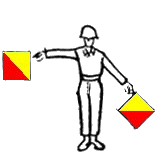
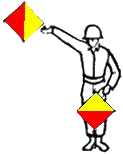
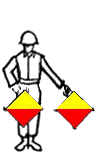
Semaphore


Signal Flags


American Sign Language

Morse Code

Binary Code

Ground-Air emergency Codes
COMMUNICATIONS
Radio and telephone
You will be trained in proper radio telephone techniques and how to operate the standard radio system issued to the SCSG. It is imperative that you master the techniques of radio operation and transmission. This training will be presented to you on site.
Phonetic alphabet.
Memorize these letters and words.
| A=Alpha |
B=Bravo |
C=Charlie |
D=Delta |
E=Echo |
F=Foxtrot |
| G=Golf |
H=Hotel |
I=In-ja |
J=Juliet |
K=Kee-lo |
L=Lee-ma |
| M=Mike |
N=November |
O=Oscar |
P=Papa |
Q=Kay-bec |
R=Romeo |
| S=Sierra |
T=Tango |
U=Uniform |
V=Victor |
W=Whiskey |
X=X-ray |
| Y=Yankee |
Z=Zulu |
1=One |
2=Two |
3=Three |
4=Fo-wer |
| 5=Five |
6=Six |
7=Sef-un |
8=Eight |
9=Ni-ner |
0=Zero |
Messaging Procedures
- Plan your messages in the field or in garrison. Write your messages down before transmission to prevent mistakes. If another person transmits the message, write it down for him.
- Listen before pushing the push-to-talk switch, do not talk over someone else.
- Speak slowly.
- Keep transmissions as brief as possible.
Message contents
- Heading. Always include the full heading in all initial messages. Example: "Two Two Actual--This is Two Two Charlie, over." In subsequent transmissions in the same message use an abbreviated heading or call. Example: "This is Two Two Actual, over."
- Text. You may use plain language, code or cipher groups
in the text, depending on the situation.
- Ending. In the ending you may include authentication. To end a message you may use the Prowords OVER or OUT, never both. OVER indicates that you expect a reply. OUT means the communication is finished.
Prowords and their meaning.
- Acknowledge. (If used, this Proword is to be included in the text of your message.) Have you received, do you understand, and will you comply with this message?
- Actual. In a heading, use of the proword ACTUAL after a unit designation means the ACTUAL COMMANDER of the unit is speaking, instead of only the radio operator.
- All after. The portion of the message to which I refer follows the text _____.
- All before. The portion of the message to which I refer precedes the text _____.
- Break. I hereby indicate the separation of the text from other portions of the message to follow in the next transmission. (Used to keep the transmission of a long message in short blocks to prevent locating or monitoring.)
- Correction. I made an error in this transmission. The transmission will continue beginning with the last word correctly transmitted.
- Disregard this transmission. The transmission that I am making is in error. Disregard it. (This proword cannot be used to disregard any message that has been completely transmitted or had been receipted or acknowledged by the recipient.)
- From. The originator of this message (not necessarily the person sending it) is indicated by the address designation immediately following. Example: "From two-two-six" indicates the message was ordered to be sent by the actual C.O. of 2nd Battalion, 2nd Brigade.
- I read back. The following is my response to your instruction to read back.
- I say again. I am repeating the entire transmission or the portion indicated.
- I spell. I shall spell the next word phonetically.
- I verify. That which follows has been verified at your request and is repeated here. (To be used only as a reply to VERIFY.)
- Message follows. A message that requires you to record is about to follow (transmitted immediately after the call.).
- Over. This is the end of my transmission to you, a response is necessary; Go ahead and transmit.
- Out. This is the end of my transmission to you, no answer is required or expected.
- Read back. Repeat this entire transmission (or portion indicated) back to me exactly as received.
- Relay to. Retransmit this message to all addresses or to the address designations immediately following.
- Roger. I have received your last transmission satisfactorily.
- Say again. Repeat all of your transmission. Followed by identification data (i.e., ALL AFTER "before 0900") it means repeat the portion of the message indicated.
- That is correct. You are correct or what you have transmitted is correct.
- This is. This transmission is from the station whose designation immediately follows.
- Time. That which follows is the time and/or date group of the message.
- Unknown station. The identity of the station with which I am attempting to establish communication is unknown.
- Verify. Verify entire message (or part indicated) with the originator and send the correct version. (To be used only at the discretion of or by the addressee to whom the questioned message was directed.)
- Wait. I must pause for a few seconds (not over 5 seconds. If longer than 5 seconds, use BREAK).
- Wilco. I have received your message, understand it, and WILL COMPLY. (Exactly the same meaning as the Naval or Marine person's response "Aye, aye, sir.")
- Word after. The word of the message to which I refer follows the text _____.
- Word before. The word of the message to which I refer precedes the text _____.
- Words twice. Communication is difficult. Transmit(ting) each phrase, word or group twice (This Proword may be used as an order or request to a sender or as information to the recipient of a message)
- Wrong. Your last transmission was incorrect. The correct version is _______.
An Exercise
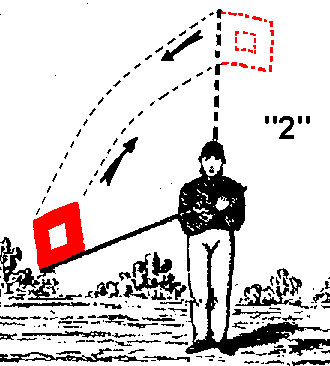
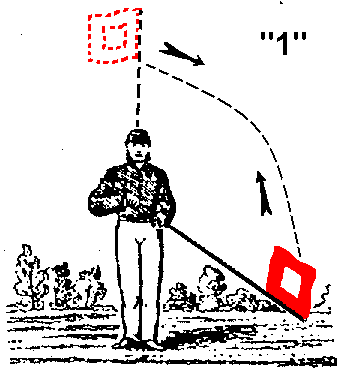
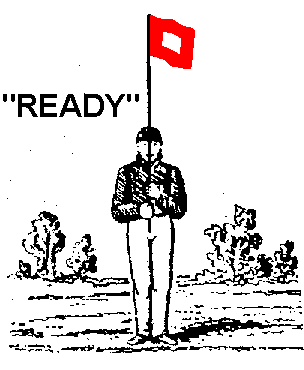
What signal is the Civil-War-era soldier sending you in these four pictures? (Hint: "Wig-Wag" signaling)
HOME
Contact the webmaster:
Major Dave Gowan
IT Sec HQ SCSG
dgowan@tfn.net