In research with immense significance for the treatment of similar diseases in humans, a Sydney scientist has used gene therapy in localised areas of the mouse brain to treat successfully a degenerative disease that results in mental retardation.
By Anne Sarzin In research with immense significance for the treatment of similar diseases in humans, a Sydney scientist has used gene therapy in localised areas of the mouse brain to treat successfully a degenerative disease that results in mental retardation.
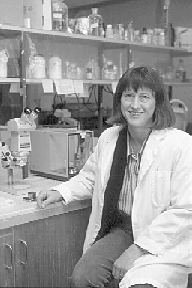
In a collaborative gene therapy research project involving mice, Dr Rosanne Taylor (pictured) of Sydney's Department of Animal Science and Dr John Wolfe of the University of Pennsylvania in the United States have successfully reversed brain damage in Sly disease, one of a group of genetic disorders known as lysosomal storage diseases.
These diseases produce lesions in the brain caused by a deficiency or absence of a specific enzyme. The production of this crucial enzyme in the brain is controlled by a gene and it is a mutation in this gene that results in an enzyme deficiency.
In their breakthrough research, Drs Taylor and Wolfe have succeeded in equipping cells with normal genes capable of replacing the deficient brain enzyme.
"Even in animals with advanced disease at the end of their lifespan, we found we could reverse the disease by introducing corrected cells that produced the missing enzyme," Dr Taylor said.
"The ability to correct established lesions will be important for the treatment of many lysosomal storage diseases affecting the human brain because most patients are not diagnosed until lesions are advanced enough to affect developmental milestones in early childhood."
Clinical features of these disorders in affected children include coarse facial features, widespread bone and joint abnormalities, hernias, thickening of heart valves, corneal clouding, progressive mental retardation and premature death.The abnormalities in the brain, however, have presented the greatest challenge to effective treatment because of that organ's relative inaccessibility.
In the most recent issue of the international journal Nature Medicine, which has an article by Drs Taylor and Wolfe on their research, an editorial review by Dr William Sly, after whom Sly disease is named, comments that Drs Taylor and Wolfe are the first to establish the principle that the secreted enzyme can reach and correct diseased cells in the brain, reducing and eliminating the brain lesions.
"The investigators [Taylor and Wolfe] report an important first step in the development of an approach to treating lysosomal storage lesions in the adult brain," the article states. "Improvements in vector design should aim to ensure higher expression levels of the therapeutic enzyme, to provide correction of pre-existing lesions over a greater distance"
Dr Taylor and Dr Wolfe's article describes the procedures whereby the animal's own skin cells (fibroblasts) were harvested and then grown in cell culture where they proliferated. Normal genetic material capable of starting production of the enzyme was introduced into these skin cells. A crippled viral vector (carrier vehicle) acts as a conduit to transfer the genes into the skin cells, which were then injected into the diseased areas of the brain.
Most of the transplanted cells containing the transferred gene appeared to remain in a cluster at the site of injection but some donor cells had migrated or diffused and were found in other parts of the brain.
These donor cells with their transferred genes produced sufficient enzyme to reverse or dramatically reduce the characteristic lesions associated with lysosomal storage diseases.
"Our results show that pre-existing lesions in the mature brain can be treated by gene therapy strategy, using cells that have been specially engineered to act as 'enzyme pumps'," Dr Taylor said. "Although the extent of this recovery was substantial in the area of the mouse brain where the genetically-changed cells were injected, the strategy will have to be extended significantly in order to treat larger brains more effectively."
Encouraged by the success of gene therapy in eliminating brain lesions in mice, Dr Taylor is hopeful that this approach will be used to treat humans affected by a range of degenerative diseases, including Tay Sachs and Gaucher's disease, and other focal neurodegenerative diseases such as Parkinson's Disease.