RUBBER STAMP CARVING TIPS
by Kirbert
updated: 4/13/2011
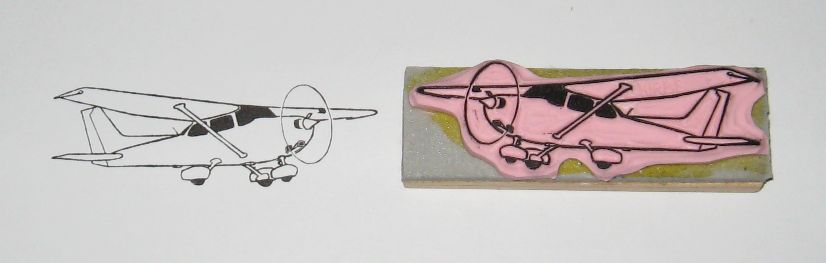
Carving rubber stamps is a lot of fun. And while
improvement through practice is a key part of the process, it
helps to get some guidance right at the outset. This site
should provide you with all the help you need to get started.
Two items of clarification:
Carving styles: First, those who carve rubber
stamps by hand generally fall into two camps: Those who
carve using a hobby knife and those who carve using a
gouge. Both types usually have both tools on hand, but
there is a fundamental difference in mindset between the two
styles. A gouge carver creates the entire rubber stamp by
cutting grooves, and only uses a hobby knife to get in tight
corners where the gouge won't reach. A hobby
knife carver creates the entire image by outlining the image
with slits in the surface of the rubber and only uses a gouge to
help remove pieces of rubber that have already been outlined
with such slits. The difference in carving styles
influences everything about their process, including the
selection of the image itself and the decision on how and what
size to carve it.
The author of this site is a hobby knife carver, and the
guidelines presented describe how to carve rubber stamps with a
hobby knife.
I should probably add that there are other methods out there as
well, including at least one web site describing how to
carve rubber stamps with a Dremel power tool. Here's
a site describing how
to make stamps out of paper.
Stamp mounting: The second issue is about mounting
the stamp. The ready-made rubber stamps you can buy at a
craft store consist of a wooden block to which is bonded a layer
of rubber containing the image with a layer of soft foam in
between. The idea is that the stamper holds the wood while
applying the rubber first to an ink pad and then to a piece of
paper, hopefully laying on a firm flat surface. The soft
foam allows the force of the application to be distributed
uniformly over the surface of the image. The methods
described on this site mimick this assembly.
There are others, though, who insist on a completely upside-down
viewpoint on how stamps are mounted and used. First off,
the stamp is not applied to the paper; rather, the stamp is laid
down face up, the ink is applied to it (either with an ink pad
or with markers), and then the paper is laid over the stamp to
make the image. Some even use a roller, called a brayer,
to apply the paper to the stamp. There are a couple of
advantages to this process; for one thing, the flat surface is
not as important, you can do it on a notebook or even your leg
and still expect to get a decent reproduction of the stamp
image. Second, it's easier to apply multiple colors to the
rubber with markers using this method. And it works better
for exceedingly large images; there are people out there carving
rubber stamps from an entire large sheet of Speedy Carve, which
is 6" x 12"!
For those who prefer this method of stamping, often the stamp is
left unmounted; just laying the bare back side of the rubber
down works fine. The rubber is highly susceptible to
damage in this condition, though, especially if the carving on
the face is very deep or the stamp is large, so many prefer to
"mount" such stamps by gluing them to a single 1/4" layer of
"fun foam". Either way, one other advantage becomes
apparent: the finished stamp is lighter and more compact
than the wood-mounted assembly, meaning it takes up less space
inside a letterbox and costs less to ship by mail.
There is one notable disadvantage to the upside-down stamping
style: it results in an inferior stamped image. It's
easy to observe the difference for yourself: carve an
unmounted stamp and stamp it upside-down several times until
you're sure you've got the best image you can. Then mount
the stamp on soft foam and wood and use it to stamp images
right-side-up. The difference will be immediately
apparent: Wood-and-foam-mounted stamps provide a
consistently superior stamp image.
This site only covers the right-side-up style of mounting, with
a soft foam layer and a wooden backing, at the present
time. Of course, there's not much more to be said about
the upside-down method than what was just said, so if you choose
to go that route you already know how.
On to learning how to carve wood-backed rubber stamps with a
hobby knife. The following is a general outline
of the steps involved, with links to discussions on each step: